
BigCommerce App Development & Platform Integrations for Connected Ecommerce Operations
Disconnected systems do not scale they break. When product data, orders, inventory, customer records, and fulfillment workflows live across tools that do not communicate, the result is manual data entry, sync errors, and operational delays that compound with every new system added. BigCommerce app development and platform integrations connect every system into one automated commerce infrastructure on BigCommerce’s Open SaaS platform.
Codinative builds custom BigCommerce applications and integration architecture connecting stores with ERP, CRM, PIM, OMS, 3PL, and marketing automation platforms using the REST API v3, GraphQL Storefront API, OAuth, Webhooks, and middleware including Celigo. We eliminate data silos and turn BigCommerce into the operational hub of the business, not just the storefront.
What BigCommerce App Development & Integrations Include
Custom BigCommerce applications and platform integrations extend functionality and connect the store with every external system ecommerce operations depend on.
Custom BigCommerce App Development
- Custom BigCommerce apps built on the App Development Framework using OAuth authentication, scoped API tokens, and the BigDesign UI library introduce automation tools, management dashboards, and operational features that App Marketplace solutions cannot deliver and stay compatible through every BigCommerce platform update because they are built inside the platform ecosystem, not alongside it.
ERP Integration
- BigCommerce ERP integrations with NetSuite, SAP Business One, Microsoft Dynamics 365, Acumatica, and Sage automate bidirectional data synchronization product data, orders, inventory levels, pricing, customer records, and financial transactions flowing between every connected system through the REST API v3 with channel-specific data routing and zero manual entry.
CRM Integration
- BigCommerce CRM integrations with Salesforce, HubSpot, Zoho CRM, and ActiveCampaign capture every customer touchpoint orders, cart activity, account creation, and purchase history syncing automatically with sales and marketing teams through Webhooks to power segmentation, lead scoring, and lifecycle automation at a scale manual processes cannot match.
Product Information Management (PIM) Integration
- BigCommerce PIM integrations with Akeneo, Salsify, inRiver, and Pimcore push structured product content — descriptions, images, specifications, and variant attributes directly into BigCommerce through the Catalog API, keeping every sales channel accurate from one central source without manual updates across multiple systems.
Why BigCommerce Integrations Matter
As ecommerce businesses scale on BigCommerce’s Open SaaS platform, operational complexity multiplies. Managing product catalogs, orders, inventory, and customer data across disconnected systems does not just create inefficiency it creates compounding risk that gets more expensive with every new system added.
Common operational challenges include:
- Manual data entry between BigCommerce and ERP or CRM systems creates pricing errors, inventory mismatches, and order discrepancies that cost revenue and damage buyer trust on every channel the business operates
- Inconsistent product data and pricing across BigCommerce storefronts and marketplace channels buyers who see different prices on different touchpoints purchase from the competitor with accurate, real-time inventory data
- Delayed order processing caused by systems that do not share data in real time orders waiting for manual sync before reaching ShipStation or ShipBob create the shipping delays that generate chargebacks and negative reviews
- Disconnected BigCommerce and Klaviyo or Omnisend data limiting campaign performance abandoned cart flows, post-purchase sequences, and segmentation all fail when purchase events arrive on a batch delay instead of instantly
- Operational failures during Black Friday and Cyber Week peak traffic every integration gap that handles normal daily order volume becomes a revenue-stopping breakdown when the business needs it most
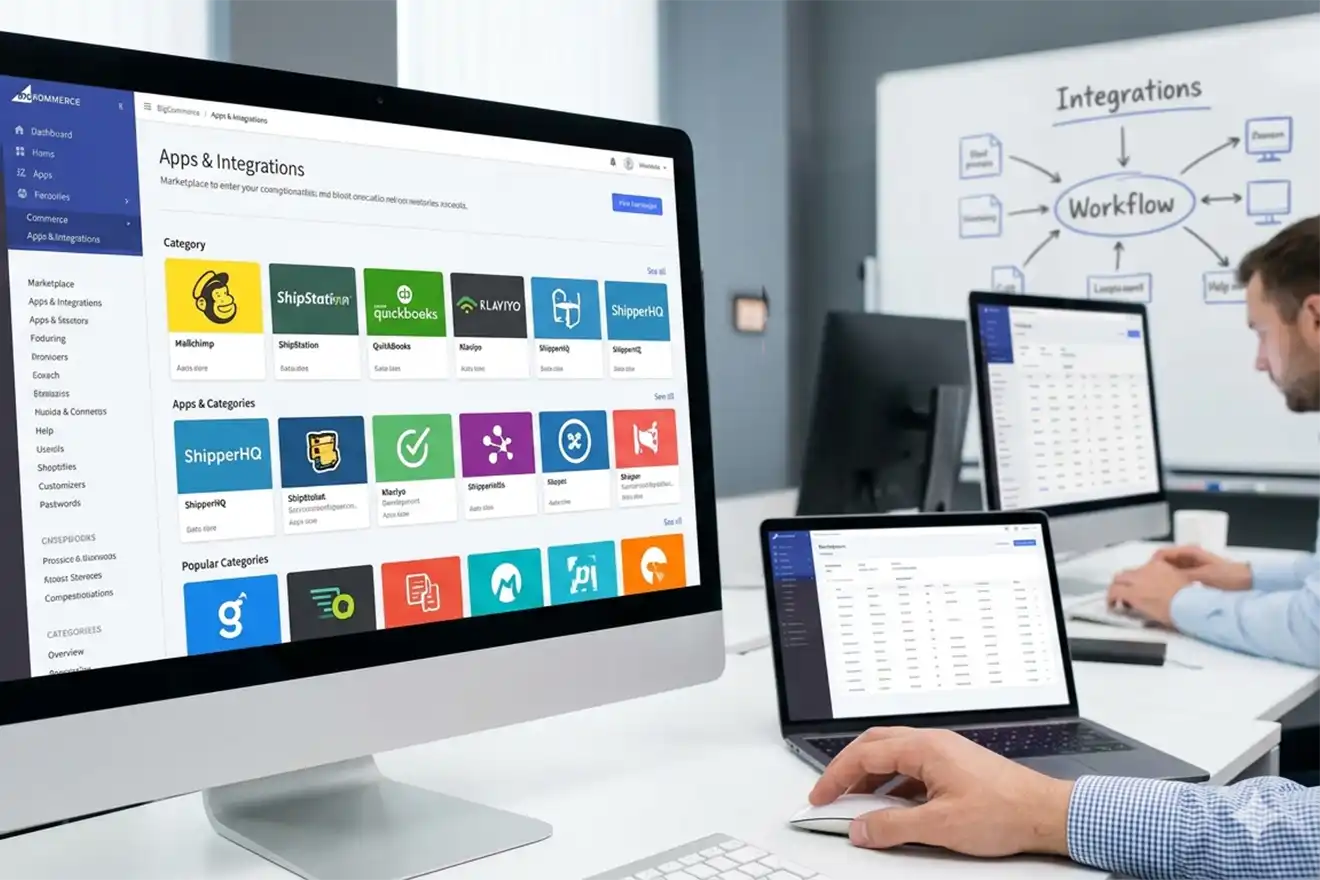
- ERP and inventory sync through the BigCommerce REST API v3 orders, stock levels, pricing, and product data flowing automatically between BigCommerce and NetSuite, SAP, or Microsoft Dynamics 365 without manual entry at any step in the workflow
- CRM data sync capturing every BigCommerce customer interaction in Salesforce or HubSpot in real time order history, cart abandonment, and purchase frequency available to sales and marketing teams the moment platform events occur
- PIM-to-BigCommerce catalog publishing through the Catalog API one update in Akeneo or Salsify propagates to every BigCommerce storefront automatically, keeping product data consistent across every channel without manual updates
- Feedonomics marketplace feed management syncing the BigCommerce catalog to Google Shopping, Amazon, eBay, and Walmart with per-channel feed optimization keeping product data, pricing, and availability accurate across every active marketplace
- Webhook-driven marketing automation connecting BigCommerce purchase events to Klaviyo and Omnisend in real time abandoned cart sequences, post-purchase flows, and customer segmentation firing on accurate live data, not end-of-day batch intervals
BigCommerce Integration Technologies
Successful BigCommerce integrations require hands-on expertise with the technical architecture, API ecosystem, and event model the platform runs on.
BigCommerce REST API (v2 & v3)
The BigCommerce REST API v3 provides programmatic access to products, orders, customers, price lists, channels, and multi-storefront settings with pagination, filtering, and batch operations for enterprise-scale data synchronization. Every order object in an MSF environment carries a channel_id integrations that ignore it assign records to channel 1 by default, creating data errors that become reporting failures by quarter end.
BigCommerce GraphQL Storefront API
The BigCommerce GraphQL Storefront API powers dynamic storefront experiences, headless builds, and Catalyst-based storefronts retrieving product data, customer sessions, cart state, and checkout details with minimal over-fetching and faster TTFB than equivalent REST endpoints. Optimized GraphQL queries reduce payload size, improve time-to-first-byte, and directly lift LCP scores on product and category pages.
OAuth Authentication & API Tokens
Custom BigCommerce apps use OAuth authentication with scoped API tokens ensuring secure, permission-controlled communication between applications and the platform. Single-click installation follows the BigCommerce Marketplace approval flow for public app distribution. Scoped tokens restrict each integration to only the platform data it requires, reducing security exposure across the full connected system stack.
Webhooks & EventDriven Automation
BigCommerce Webhooks trigger automated processes the instant platform events occur order creation, inventory threshold alerts, customer registration, shipment status changes, and refund processing across every connected system. No polling loops. No scheduled batch jobs. Systems stay synchronized the moment something changes in BigCommerce, not on the next scheduled sync cycle.
BigCommerce Integrations for Enterprise Ecommerce
Enterprise ecommerce on BigCommerce’s Open SaaS platform runs on multi-system technology stacks. Integration architecture is the backbone of operational efficiency not a secondary concern addressed after the storefront launches.
Real enterprise integration scenarios that require platform-level expertise include:
- Manual data entry between BigCommerce and ERP or CRM systems creates pricing errors, inventory mismatches, and order discrepancies that cost revenue and damage buyer trust on every channel the business operates
- Inconsistent product data and pricing across BigCommerce storefronts and marketplace channels buyers who see different prices on different touchpoints purchase from the competitor with accurate, real-time inventory data
- Delayed order processing caused by systems that do not share data in real time orders waiting for manual sync before reaching ShipStation or ShipBob create the shipping delays that generate chargebacks and negative reviews
- Disconnected BigCommerce and Klaviyo or Omnisend data limiting campaign performance abandoned cart flows, post-purchase sequences, and segmentation all fail when purchase events arrive on a batch delay instead of instantly
- Operational failures during Black Friday and Cyber Week peak traffic every integration gap that handles normal daily order volume becomes a revenue-stopping breakdown when the business needs it most
BigCommerce Maintenance & Engineering Support
BigCommerce SEO & Performance Optimization
Talk With Expert
+123 456 789 10
info@codinative.com
BigCommerce Integration Process
Integration Architecture Planning
We map every system connecting to BigCommerce data flows, sync direction, channel_id handling, error logic, and authentication architecture before writing a single line of code. Decisions made here determine whether the platform scales cleanly or produces data errors across every connected system.
App Development & API Integration
Custom apps and integrations are built on the REST API v3, GraphQL Storefront API, OAuth, and Webhooks with all data flows, error handling, failover logic, and channel-specific routing tested against real operational data in staging before any connection touches the live BigCommerce store.
Testing & Deployment
Every integration is tested end to end across all connected systems before zero-downtime deployment. Post-launch, Webhook delivery health, API error rates, and data sync accuracy are monitored continuously so failures are caught and resolved before they reach orders, inventory, or customer records.