
BigCommerce Multi Storefront Development for Global Ecommerce
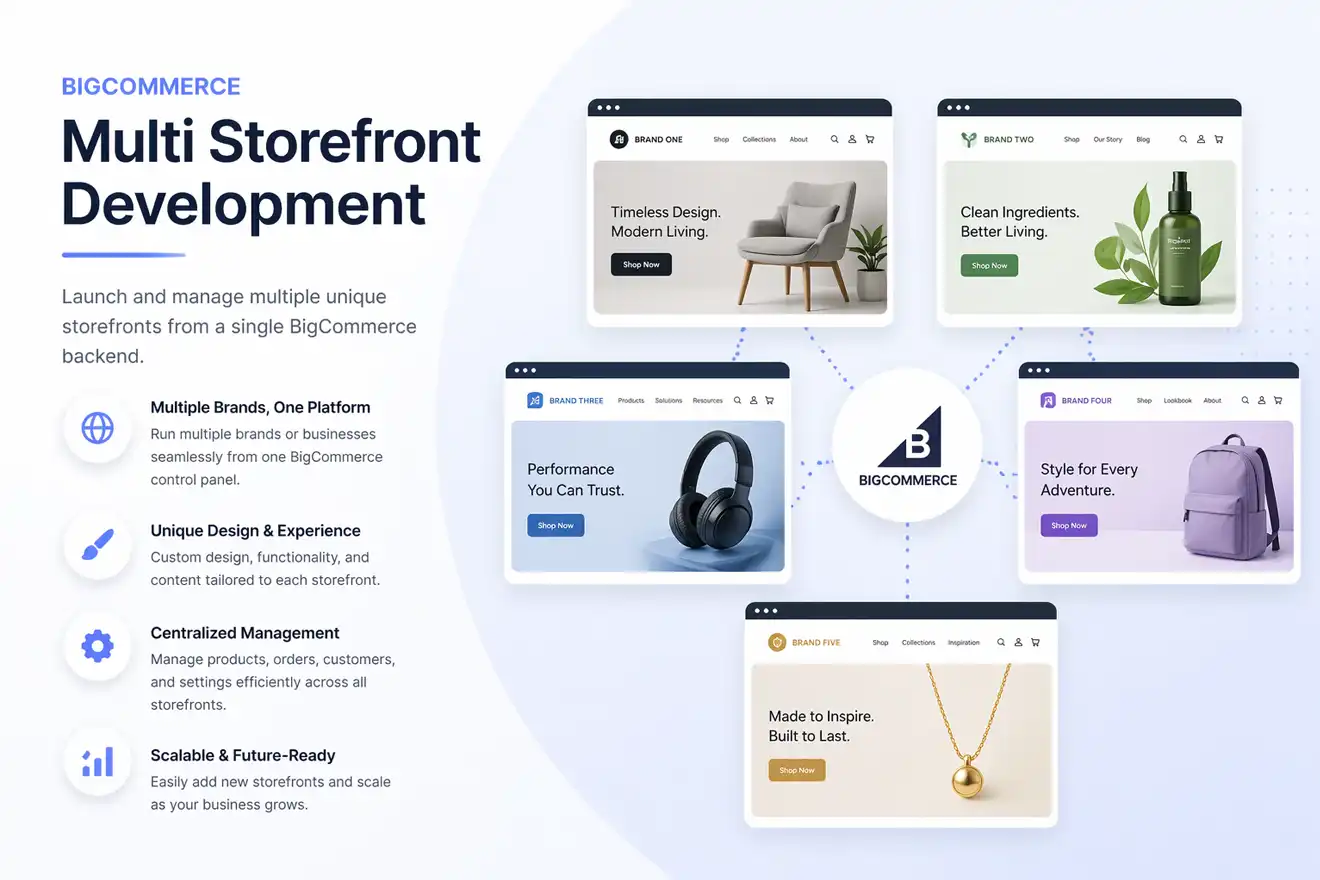
One backend. Multiple storefronts. Different regions, currencies, languages, and brands all from a single BigCommerce control panel. Running separate store accounts for each market creates duplicated catalog work, inconsistent pricing, and data errors that compound with every storefront added.
Codinative implements BigCommerce Multi Storefront (MSF) architecture for US and international ecommerce businesses expanding across markets and brands keeping product catalogs, inventory, pricing, and order management centralized while every storefront operates independently for its market.
What BigCommerce Multi Storefront Development Includes
BigCommerce Multi Storefront requires precise Channels API architecture. The wrong setup creates data problems — orders on the wrong channel, pricing on the wrong market, integrations that ignore channel_id that surface months later as operational and financial errors.
Multi-Brand Storefront Architecture
- Each brand runs as its own channel in the BigCommerce Channel Manager with its own domain, SSL, Stencil theme or headless frontend, category tree, price list, and customer group. One catalog. One backend. Zero duplicate data entry. BigCommerce Pro supports up to 5 Stencil and 15 headless storefronts Blueprint themes must migrate before MSF can be enabled.
Regional Storefront Deployment
- Each BigCommerce MSF channel is configured through the Channels API with its own domain, currency, price list, regional tax rules, and product assortment via the Catalog API channel assignments feature. Per-channel hreflang tags signal the correct language and region to Google so each storefront ranks in its own market without splitting organic signals.
Multi-Currency Ecommerce
- Each storefront channel runs its own transactional currency USD for the US, GBP for the UK, CAD or AUD for other markets through the Channels API. Per-channel price lists, tax rules, and promotions apply at checkout automatically. Orders and refunds are attributed to the correct channel and currency throughout the full post-purchase workflow.
Multi-Language Storefront Localization
- BigCommerce MSF configures translated product descriptions, navigation labels, CMS pages, and email templates per channel not globally. On BigCommerce Enterprise, MSF International Enhancements set product names and variant labels per locale at the catalog level. The Catalyst composable framework and GraphQL Storefront API deliver localized pages that rank in regional Google searches.
Why Businesses Use BigCommerce Multi Storefront?
Scaling ecommerce across markets, brands, or buyer segments creates problems a single storefront cannot solve no matter how well it is configured
Businesses need
- Multiple brand storefronts under one BigCommerce account each with its own domain, catalog, and checkout without separate logins or duplicated product management
- Regional pricing and tax rules per market USD, GBP, and VAT configured through the Channels API and enforced at checkout automatically
- Channel-specific product catalogs Catalog API channel assignments controlling exactly which SKUs appear on which storefront per market
- Translated content per channel product descriptions, navigation, and emails in the buyer's language, not one global configuration applied everywhere
- Separate B2B and B2C experiences wholesale pricing and purchase orders on one channel, retail guest checkout on another, from the same catalog
- Per-channel catalog control through the Catalog API right SKUs, right pricing, channel-specific promotions enforced at checkout with zero duplicate data entry
- Centralized inventory across all channels one real-time stock count synchronized with NetSuite, SAP, and Microsoft Dynamics through the REST API v3
- Independent SEO and hreflang per storefront separate meta titles, XML sitemaps, and hreflang annotations so every regional storefront ranks in its own market
- Feedonomics marketplace feeds BigCommerce catalog synchronized to Google Shopping, Amazon, eBay, and Walmart with per-channel optimization
- B2B and B2C storefront separation on one backend wholesale company accounts, contract pricing, and purchase order workflows on one channel retail buyers with guest checkout on another from the same product catalog
BigCommerce Multi Storefront Technology
MSF implementation runs at the Channels API, Catalog API, and REST API v3 level. Every channel, every integration, and every data object must be scoped by channel_id from the start surface-level admin panel configuration is not enough.
BigCommerce Multi Storefront (MSF) Feature
BigCommerce launched native Multi Storefront in March 2022 on Pro and Enterprise plans only. Each storefront runs as a separate channel with its own domain, SSL, theme, category tree, price list, and currency sharing one backend. Standard plan stores cannot access MSF. Blueprint themes must migrate to Stencil or headless before MSF can be enabled.
Channels API & Channel Management
Every BigCommerce storefront, marketplace (Amazon, eBay, Walmart), and POS system runs as a channel object through the Channels API with per-channel control over product assignments, pricing, and content. Integrations that miss channel_id assign all records to channel 1 by default creating data errors that become mis-attributed revenue and reporting failures by quarter end.
Category Trees Per Channel
BigCommerce supports multiple category trees independently assignable per storefront channel B2B channels show wholesale categories, DTC channels show retail, regional channels show localized ranges. The same product sits in one shared catalog what each buyer sees is controlled entirely by which channel they shop, with no duplicate structures or manually maintained navigation.
APIDriven Integrations
The BigCommerce REST API v3 and GraphQL Storefront API connect MSF environments to ERP systems (NetSuite, SAP, Microsoft Dynamics), CRM platforms (Salesforce, HubSpot), PIM tools (Akeneo, Salsify), and OMS/3PL providers with channel-aware data routing keeping each storefront's data correctly scoped across every connected system.
BigCommerce International Ecommerce on Multi Storefront
Selling internationally means more than translating product pages. Every storefront must meet the specific requirements of the market it serves pricing, tax, language, and compliance all differ per market and must be configured per channel.
Core international requirements include:
- Multiple brand storefronts under one BigCommerce account each with its own domain, catalog, and checkout without separate logins or duplicated product management
- Regional pricing and tax rules per market USD, GBP, and VAT configured through the Channels API and enforced at checkout automatically
- Channel-specific product catalogs Catalog API channel assignments controlling exactly which SKUs appear on which storefront per market
- Translated content per channel product descriptions, navigation, and emails in the buyer's language, not one global configuration applied everywhere
- Separate B2B and B2C experiences wholesale pricing and purchase orders on one channel, retail guest checkout on another, from the same catalog
BigCommerce Maintenance & Engineering Support
BigCommerce SEO & Performance Optimization
Talk With Expert
+123 456 789 10
info@codinative.com
BigCommerce Multi Storefront Development Process
Platform Architecture Planning
We map every storefront, catalog assignment, price list, tax rule, and channel-aware integration requirement before a single channel is created so the architecture scales cleanly from day one.
Storefront Development & Configuration
Each channel is built in the Channel Manager with its own domain, SSL, theme, category tree, price list, currency, and hreflang with all ERP, PIM, and Feedonomics integrations validated by channel_id in staging before go-live.
Testing & Deployment
Every storefront is tested across devices, checkout flows, currencies, and regional pricing in staging before zero-downtime deployment followed by per-channel Core Web Vitals verification and conversion tracking validation.